
The 5 prayers of Islam are Fajr, Dhuhr, Asr, Maghrib, and Isha performed at dawn, midday, afternoon, sunset, and night. Known collectively as Salah, they make up the second of the Five Pillars of Islam and are obligatory for every adult Muslim. Each prayer has a set time window, a required number of rakahs (units), and follows the same basic structure of standing, bowing, and prostrating while facing Mecca.
What Are the 5 Prayers of Islam?
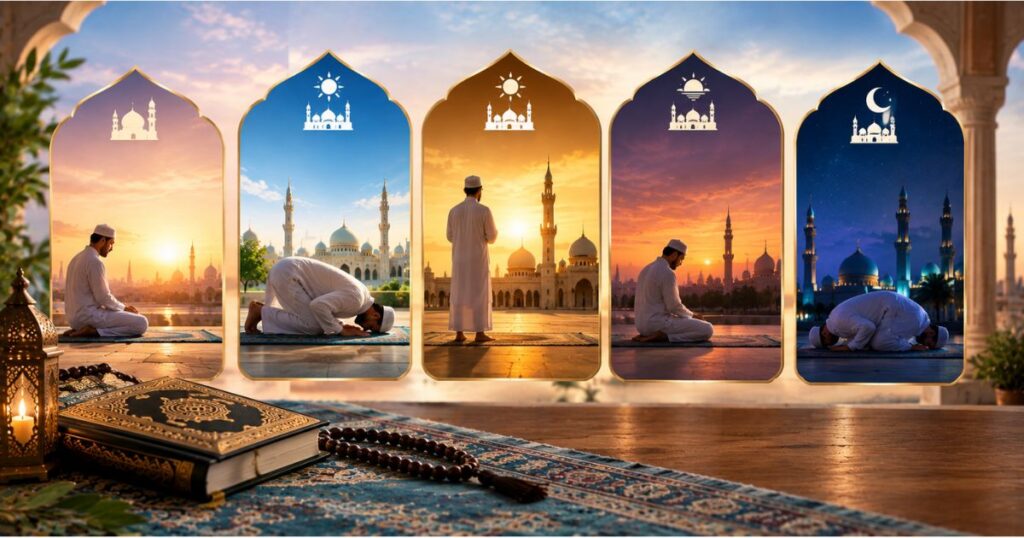
Salah is the ritual prayer performed by Muslims five times daily, and it’s the second of the Five Pillars of Islam the core practices that structure a Muslim’s faith and daily life. The word is also written as salat or referred to as namaz in South Asian communities.
Salah isn’t the same as dua, the informal, personal supplication Muslims can make to God at any time, in any language. Salah is fixed: specific words, specific movements, specific times, always facing the Qibla (the direction of the Kaaba in Mecca). It’s one of the visible acts of worship that sits alongside the Six Pillars of Iman what a Muslim believes as the practical expression of what a Muslim does.
Its obligation traces back to one of the earliest and most-cited hadiths in Islamic tradition. According to an account preserved in Sahih Muslim, when a man asked the Prophet Muhammad how many prayers were required of him, the answer was five during the day and night with anything beyond that being voluntary. That exchange is why five, not ten or three, is the fixed number every school of Islamic thought agrees on a question also covered in detail in How Many Times Do Muslims Pray a Day?
The 5 Daily Prayers, Names & Times
Prayer times shift daily with sunrise and sunset, so exact clock times depend on your location but the windows they fall into are fixed. For a full breakdown of each prayer’s meaning and structure, see Names of Prayers in Islam.
| Prayer | Arabic Meaning | Time Window | Rakahs (Farz) |
| Fajr | Dawn | From dawn until sunrise | 2 |
| Dhuhr | Midday | After the sun passes its highest point, until Asr begins | 4 |
| Asr | Afternoon | Mid-afternoon until just before sunset | 4 |
| Maghrib | Sunset | Just after sunset until twilight fades | 3 |
| Isha | Nightfall | After twilight disappears until midnight (or later, depending on school of thought) | 4 |
Fajr (Dawn Prayer)
The first prayer of the day, prayed before sunrise. It’s short just 2 obligatory rakahs but many Muslims consider it spiritually significant precisely because it requires waking before the world does. For exact local timings, check Fajr Prayer Time in Houston or Fajr Prayer Time in Chicago, and see the full rakah breakdown in How Many Rakats Are in Fajr Prayer?
Dhuhr (Midday Prayer)
Prayed once the sun has passed its zenith. On Fridays, Dhuhr is replaced by Jummah, the congregational Friday prayer, which includes a sermon and is one of the few prayers Muslim men are obligated to attend at a mosque.
Asr (Afternoon Prayer)
The mid-to-late afternoon prayer, ending just before sunset. Traditionally, it’s considered better to pray Asr early in its window rather than close to sunset.
Maghrib (Sunset Prayer)
Begins immediately after sunset. During Ramadan, Maghrib marks the moment the daily fast is broken timings that shift each year with the Islamic Calendar.
Isha (Night Prayer)
The final prayer, prayed once twilight has fully disappeared. It’s the only prayer commonly followed by Witr, an additional set of rakahs many Muslims pray before sleeping and for those who want to go further, many extend their night with Tahajjud, the voluntary night prayer.
How Many Rakahs Are in Each Prayer? (Farz vs. Sunnah vs. Nafl)

This is where a lot of guides online get inconsistent; some list only the obligatory rakah count, others add in optional prayers and end up with much higher totals. Both are technically correct; they’re just answering different questions. For the complete chart across all five prayers, see How Many Rakahs Are in Each Prayer? Complete Chart.
- Farz (Fard): Obligatory rakahs. Missing these is a sin. This is the count in the table above.
- Sunnah: Rakahs the Prophet Muhammad regularly performed alongside the farz prayers. Highly recommended but not sinful to skip.
- Nafl: Voluntary extra rakahs a person can pray for additional reward entirely optional.
| Prayer | Farz (Obligatory) | Typical Sunnah | Optional Extras |
| Fajr | 2 | 2 (before) | — |
| Dhuhr | 4 | 4 (before) + 2 (after) | Nafl |
| Asr | 4 | 4 (before, optional) | — |
| Maghrib | 3 | 2 (after) | Nafl |
| Isha | 4 | 2 (after) | Witr (3), Nafl |
Note: exact Sunnah/Nafl practices vary slightly between the four main Sunni schools of thought (Hanafi, Shafi’i, Maliki, Hanbali). The Farz counts, however, are agreed upon universally.
What You Do Before Praying: Wudu and Qibla
Two things happen before any of the five prayers begin.
Wudu is the ritual washing of the hands, face, arms, and feet, performed before every prayer to enter a state of physical and spiritual cleanliness. If a person is unable to access water, an alternative dry purification (tayammum) is permitted. Wudu is just one part of the wider concept of Purity in Islam (Taharah), which covers physical cleanliness, ritual ablution, and spiritual purity together.
Qibla is the direction Muslims face when they pray: toward the Kaaba, the cube-shaped structure in Mecca, Saudi Arabia. Most mosques mark this direction physically, and prayer apps calculate it automatically based on your location.
Why Do Muslims Pray 5 Times a Day?
The five daily prayers aren’t just a religious obligation practicing Muslims describe them as a built-in rhythm for the day. For the full explanation of the purpose behind Salah, read Why Do We Pray in Islam? The Real Purpose of Salah Explained. Common reasons cited include:
- Spiritual grounding five fixed check-ins with God throughout the day, rather than one weekly service
- Discipline the fixed schedule builds consistency and time-awareness
- Physical reset the standing, bowing, and prostrating movements offer brief physical activity between long periods of sitting or work
- Community praying in congregation, especially Friday Jummah, reinforces a shared sense of belonging
One widely cited hadith compares the five daily prayers to washing in a river five times a day just as no dirt would remain after that, the prayers are described as removing a person’s sins.
What Happens If You Miss a Prayer?
Missing a prayer isn’t treated as unforgivable, but it isn’t shrugged off either. Islamic teaching generally holds that:
- Qada (makeup prayers): A missed prayer should be made up as soon as possible, in the same order it was missed.
- Combining prayers: Dhuhr with Asr, and Maghrib with Isha, can be combined in specific circumstances, travel, illness, or genuine hardship, a concession most schools of thought recognize.
- Shortening prayers while traveling: Travelers are permitted to shorten the 4-rakah prayers (Dhuhr, Asr, Isha) to 2 rakahs.
Praying in the Workplace or While Traveling
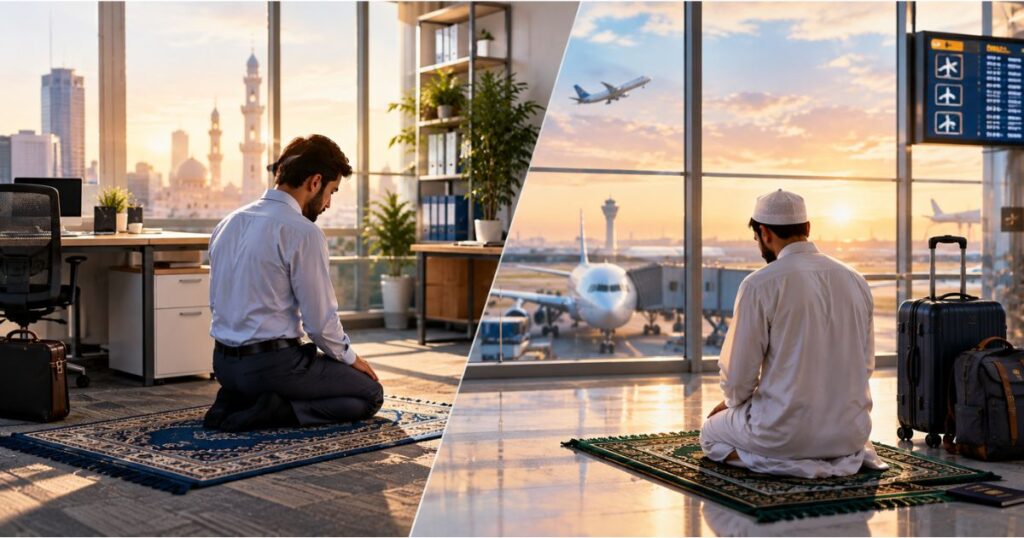
For US-based readers who aren’t Muslim but manage Muslim colleagues, students, or clients, a few practical notes:
- A typical 9-to-5 workday usually overlaps with Dhuhr and sometimes Asr, meaning a Muslim employee may need one or two short breaks (5-10 minutes) during the day.
- A quiet, clean space, even an unused meeting room is generally all that’s needed.
- Fajr and Isha typically fall outside standard work hours and rarely require accommodation.
For Muslims traveling or new to a fixed prayer schedule, prayer-time apps that auto-calculate Fajr through Isha based on GPS location are the most common practical solution to staying on schedule without memorizing local sunrise/sunset tables. New reverts often start with our 7-Day Learning Plan to build this habit gradually, or explore the full Prayer Guide for a step-by-step walkthrough.
Conclusion
The 5 prayers of Islam Fajr, Dhuhr, Asr, Maghrib, and Isha aren’t just a religious checklist. They’re a rhythm that repeats every single day, tying a Muslim’s schedule to something bigger than the workday or the news cycle. Whether you’re a new Muslim learning the rakah counts for the first time, or a manager trying to understand why a colleague steps out for ten minutes around 1 p.m., the structure is the same everywhere: five fixed windows, facing Mecca, five times closer to God. Get the times and rakahs down, and the rest the discipline, the community, the meaning tends to follow.
FAQs
Do Muslims have to pray in Arabic?
Yes, the fixed portions of Salah including Quranic recitation are performed in Arabic regardless of the worshiper’s native language. Personal supplications (dua) outside of formal prayer can be made in any language.
Can women pray at home instead of at the mosque?
Yes. Women have the option to pray at home or in congregation; it isn’t obligatory for women to attend the mosque the way Friday Jummah is for men.
What is Jummah?
Jummah is the Friday congregational prayer that replaces the regular Dhuhr prayer. It includes a sermon (khutbah) and is obligatory for Muslim men to attend at a mosque.
How long does one prayer take?
A single prayer, including wudu, typically takes 5-10 minutes, though this varies based on how much is recited and whether it’s prayed individually or in congregation.
Can I combine Dhuhr and Asr?
Yes, under recognized circumstances such as travel or illness, Dhuhr and Asr and separately, Maghrib and Isha can be combined and prayed together.